In September 2013, I received an invitation from the Moscow Urban Forum to submit an article on Jakarta. The Moscow Urban Forum was an international event for experts, investors, and potential partners interested in the development of Moscow and held on December 5-7, 2013. One of the outcomes of the Moscow Urban Forum is the multidisciplinary research of the periphery of megacities. More than 10 megacities were parts of the research including Jakarta. The Moscow Urban Forum has released the report of the research titled "Archaeology of the Periphery" as can be found at this link. The report includes my article of Jakarta titled "Peripheral Pressures" on pp. 162-171. This post is the extension of that article and will be presented in the Spring 2014 Seminar Series in the Center for Southeast Asian Research (CSEAR) at the University of British Colombia in Vancouver, Canada on May 1, 2014.
Introduction
Jakarta is the capital of
Indonesia and the largest metropolitan area in Southeast Asia with tremendous
population growth and a wide range of urban problems. The overall population of
the megacity of Jakarta grew in the 20th Century, from about 150,000 in 1900 to
about 28 million in 2010. The megacity of Jakarta is also called Jabodetabek, taken from the initial
letters of the administrative units of Jakarta, Bogor, Depok, Tangerang and
Bekasi. The center of Jabodetabek is
Jakarta, also called the Special Capital Region of Jakarta (Daerah Khusus Ibukota Jakarta) and covers
a total area of 664 square kilometers. The inner peripheries of the megacity of
Jakarta include four municipalities (City of Tangerang, City of South
Tangerang, City of Depok, City of Bekasi), whereas the outer peripheries of
Jabodetabek include the City of Bogor, Tangerang Regency and Bekasi Regency. The megacity covers a total area of 5,897 square kilometers
(Hudalah and Firman 2007).
 |
| Skyline of Jakarta, January 2014 |
Jakarta, or the Special Capital
Region of Jakarta, has ‘provincial
government level’ status. The peripheries of Jabodetabek are within the
jurisdiction of two provinces. The City
of Bogor, City of Depok, City of Bekasi and Bekasi Regency are within the
jurisdiction of West Java Province, whereas the City of Tangerang, City of South
Tangerang and Tangerang Regency are within the jurisdiction of Banten Province.
The four municipalities within the inner peripheries of Jabodetabek are new
municipalities founded in the 1990s and 2000s. The City of Tangerang, City of
Bekasi, City of Depok and City of South Tangerang were founded in 1993, 1996,
1999 and 2008 respectively. The City of Tangerang and City of South Tangerang
seceded from Tangerang Regency. Meanwhile, the City of Depok was part of Bogor
Regency and the City of Bekasi seceded from Bekasi Regency.
Population Growth of
the Megacity of Jakarta
Jakarta has
been the capital of Indonesia since the Dutch colonial era. The population of
Jakarta in 1900 was about 115,000. In the first nationwide census of the Dutch
colonial administration (1930), Jakarta’s population increased to 409,475. In the
next ten years, the population increased to 544,823 with an annual growth rate
of 3.30%. After Independence, Jakarta increased by nearly three times to 1.43
million by 1950. It increased to 2.91 million in 1960 and 4.47 million in 1970.
The annual growth rates of Jakarta’s population are 10.35% and 5.36% (1950-1960
and 1960-1970 respectively).
Table 1 shows
the population of the Megacity of Jakarta including Jakarta, the inner and
outer peripheries of Jakarta, from 1980 to 2010. The Megacity of Jakarta
increased from 11.91 million in 1980, 17.14 million in 1990, and 20.63 million
in 2000 to 28.01 million in 2010. The megacity in 2010 was 11.79 percent of Indonesia’s
total population but this population resides in less than 0.3 percent of
Indonesia’s total area. The proportions of Jabodetabek’s population to the
total population of Indonesia have steadily increased from 8.07%, 9.56%, to 10.0%
(in 1980, 1990, and 2000 respectively).
Transformation of Jakarta
The
modern city of Jakarta was initiated by President Soekarno’s strong vision to
build Jakarta into the greatest city possible (Cybriwsky and Ford, 2001). He
gave Jakarta, Monas – his most symbolic new structure the 132 m high national
monument, spacious new government buildings, department stores, shopping
plazas, hotels, the sport facilities of Senayan that were used for the 1962
Asian Games, the biggest and most glorious mosque of Istiqlal, new parliament
buildings and the waterfront recreation area at Ancol. Such constructions
continued under the New Order regime that began in 1967. Under this
regime, Indonesia enjoyed steady economic growth, along with a reduction in the
percentage of the population living under the poverty line (Firman 1999). From
40% in 1976, the levels declined to the official level of 11.3% in 1996. In 1996 6.9 million people in urban areas and
15.7 million people in rural areas lived under the poverty line.
Jakarta grew
rapidly during this period of the New Order regime. The investment in the
property sector, including offices, commercial buildings, new town development,
and highrise apartments and hotels grew substantially. Firman (1998; 1999)
argued that Jakarta, by the mid-1990s, was heading towards global city status.
Jakarta was the largest concentration of foreign and domestic investment in
Indonesia and received US$ 32.5 billion and Rp. 68,500 billion from foreign and
domestic investment respectively during the period of January 1967-March 1998
(Firman 1999).
In the
early administration of the New Order regime, some projects were completed,
including the Ismail Marzuki Arts Center, industrial zones at Tanjung Priok and
Pulo Gadung, that aimed to attract foreign investment, plus the unique theme
park of Taman Mini Indonesia Indah. During the thirty-two years of the New
Order regime, Jakarta changed considerably. A generally rapid economic growth
during this period allowed Jakarta to expand its modern constructions and
develop into a modern city. Firman (1998; 2000) noted that the physical development
of Jakarta resulted from its functioning as a “global city” in Asia. The
“global cities” in Asia include Tokyo, Seoul, Taipei, Hongkong, Manila,
Bangkok, Kuala Lumpur, Singapura and Jakarta. Hundreds of new office towers,
hotels and high-rise condominiums were built in many parts of the city.
 |
| M.H. Thamrin Blvd, Jakarta. January 2014 |
Murakami
and her colleagues (2005) compared the urbanization stage and patterns of land
use in Jakarta, Bangkok dan Manila. Using the Clark linear exponential model
and the Newling quadratic exponential model, they compared the spatial distribution
of population densities in those cities. They also analyzed land-use patterns
by examining the mixture of urban and agricultural land use. They found that
Jakarta had entered the suburbanization stage,
while Manila was at early stage of suburbanization and Bangkok was at
intermediate stage of suburbanization. The Golden Triangle – a new style
commercial zone - was built in Thamrin-Sudirman corridor to push the urban
skyline upward in response to high land costs in key areas and the convenience
of the automobile (Cybriwsky and Ford, 2001). This zone aimed to accommodate
internationally invested highrise mega-blocks; a result of the regional competition
among “global cities” (Firman, 1998; Goldblum and Wong, 2000).
Jakarta
is linked with other “global cities” in a functional system built around
telecommunications, transportation, services and finance. A parade of tall buildings,
one after the other fill the major streets on both sides. They house the
offices of Indonesian and multi-national corporations. Firman (1999) reported
that total area of commercial space in Jakarta in 1978 was only 0.1 million
square meters and in 1997 it reached 2.7 million square meters with nearly 90% occupancy
rates. In every part of the city, modern shopping malls along with family
enterprises were also built.
The
economy crisis which hit Indonesia in 1998 resulted in major disruptions of the
urban development in Jakarta. Such monstrous crisis shifted Jakarta from
“global city” to “city of crisis”. The crisis – commonly known in Indonesia as krismon - largely squeezed the economy of Jakarta.
Domestic and foreign investment dramatically fell off. Many manufacturing and
services corporations in the megacity of Jakarta closed and laid off their employees,
resulting in the rapid increase of uncontrolled unemployment. In order to
survive the krismon,
a large number of
workers shifted to become food traders or then engaged in other informal sector
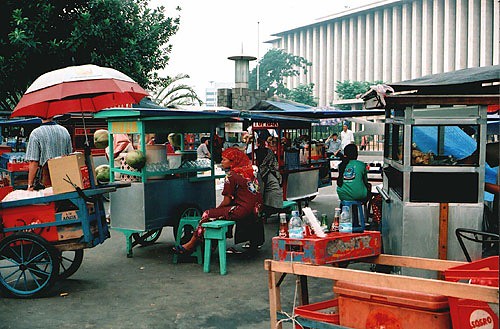
jobs. Street vendors –commonly known in Indonesia as pedagang kaki lim a- increased rapidly from about 95,000 in
1997 to 270,000 in 1999 (Firman, 1999). The increasing informal labor force is
a distinctive characteristic of cities in developing countries since the formal
sector fails to accommodate a large labor force. This shrinkage of economic
activities resulted in the decrease of office space demand which dropped from
300,000 square meters in 1997 to 85,000 square meters in 1999. Similarly, the
demand for high-class apartments dropped from 49,000 in December 1997, to
16,000 in February 1998. The housing market in the megacity nearly collapsed
due to increasing costs of building materials and higher housing loan interest
rates. Most construction projects in the periphery of Jakarta slowed down or
even completely stopped (Firman, 2000).
In order
to mitigate the impact of the krismon,
in July 1998 the government along with the assistance
of IMF launched a variety of social safety net programs. These programs included
food security, employment creation, student scholarships and block grants to
schools, targeted health care subsidies, and community block grant (Sumarto,
et. al., 2004). Political and economic reforms were also implemented during the
recovery process. Civil unrest and political uncertainty heightened during the krismon gradually lowered during the recovery
process. As of early 2005, Indonesia’s economic performance was more positive. The
rate of economic growth of Jakarta was 5.26% per year over the period of
2001-2004 (Firman 2008).
Suburbanization
in the Megacity of Jakarta
To understand the suburbanization
in the megacity of Jakarta, it is essential to recognize the socio-economic
dualism pervading Indonesian urban society. The manifestations of this dualism
are the presence of the modern city and the kampung city in urban areas. The kampung, ‘village’ in Indonesian, is
associated with informality, poverty, and the retention of rural traditions within
an urban setting. Firman (1999) argues the existence of kampungs and modern cities reflect spatial segregation and
socio-economic disparities.
 |
| Kampung and the modern city of Jakarta, January 2014 |
The growing numbers of migrants
to Jakarta and poor Jakarta natives have produced new squatter kampungs on the
periphery of Jakarta (Cybriwsky and Ford, 2001). Many constructions in the
central city also caused some residents of kampungs to be evicted and relocated
to the periphery (Silver, 2008). The periphery also attracted migrants because
of its improved infrastructures and facilities in (Goldblum and Wong, 2000). Since
1950, Jakarta has attracted people from all parts of Java and other Indonesian
islands. The flood of migrants came to Jakarta for economic reasons as Jakarta
offered the hope of employment. The 1961 census showed only 51% of the city’s
population was actually born in Jakarta (Cybriwsky and Ford, 2001). And many
times, Jakarta officials tried to control migration by declaring the city
closed; new migrants were not allowed entry. However, these attempts proved
useless; a large number of migrants ignored the law.
Leaf (1994) has identified the rapid
growth of suburban enclave housing in Jakarta during early 1990s. The
residential enclave for narrowly targeted moderate and high-income families
characterized Jakarta’s suburban area (Firman, 1998; Leaf, 1994). Located on
the periphery of the city, these settlements were built in
automobile-accessible areas with various high-quality amenities such as modern
golf courses. High-income families in the central city also moved from the city
in search of better living quality (Goldblum and Wong, 2000). The high cost of
houses and the need for automobiles restricted low-income families from the
suburban housing market. One in five families in Jakarta’s suburbs owned an
automobile (Leaf, 1994). Leaf (1994) has argued that suburbanization in Jakarta
was a direct outcome of at least two policies: the subsidized housing finance
program and the municipal permit system for land development. These policies
have most benefited developers strongly linked with the New Order Regime. Half
of the land development permits were given to 16 development firms. The other half
was distributed amongst the other 167 development firms (Leaf, 1994).
In addition to residential zones,
the periphery of Jakarta is also made up of specialized zones of commercial and
industrial enterprises. These areas complement the other districts of Jakarta:
the central business districts on Thamrin-Sudirman corridor, the government
offices around Medan Merdeka, the international seaport of Tanjung Priok, and
the growing network of freeways. Since the end of the 1980s, no new industrial
parks have been developed in Jakarta (Hudalah et al 2013). Initiated by a
collaborative project of Bumi Serpong Damai in the early 1980s, the periphery
of Jakarta was also the location of several new towns. The first new town of
Bumi Serpong Damai was planned for an eventual population of 600,000 in a total
area of 6,000 hectares; a project developed by several private developers and
led by the largest private developer – the Ciputra Group. Other new towns in
the peripheries of Jakarta include Bukit Jonggol Asri, Pembangunan Jaya, Lippo
City, Cikarang Baru, Tigaraksa, Kota Legenda, Kota Cileungsi, Royal Sentul,
Bintaro Jaya, Lido Lakes Resort, Gading Serpong, Modernland, Kota Citra Raya
and Alam Sutera dan Kedaton (Firman 1998; Silver 2008).
In a number of these new towns,
the State Housing Provider Agency (Perumnas) joined with private developers to
assure some housing was targeted for low and moderate-income families
(Cybriwsky and Ford, 2001). Most of the new towns offered relatively few
employment opportunities. Their initial concept was to create self-contained
communities but this was barely implemented. Instead, the new towns became
“bedroom suburbs for city-bound commuters” (Cybriwsky and Ford, 2001). The new
towns were still heavily dependent on the central city (Firman, 1999; Silver
2008) and the development of large-scale housing projects intensified the daily
interaction between the fringe areas and the central city of Jakarta. This
worsened the traffic problems in metropolitan Jakarta. The development of
industrial zones in the peripheries of Jakarta also indicated a spatial
restructuring that shifted manufacturing from the central city to the
periphery. Firman (1998) reported that the central city attracted disproportionate
investment in service industries, trade and hotel, and restaurant construction.
The peripheries attracted most of the industrial construction; these include
textiles, apparel, footwear, plastics, chemicals, electronics, metal products
and foods (Cybriwsky and Ford, 2001). In
the peripheries of the megacity of Jakarta, agricultural areas and forests were
massively converted into industrial estates, large-scale subdivisions and new
towns (Firman 1999; Silver 2007). Within 10 years, 20 new towns emerged in the megacity
of Jakarta and converted 16.6 thousand hectares of rural land (Winarso and
Firman 2002, p. 488).
The massive
development on the outskirts of the megacity of Jakarta resulted from a series
of deregulation and de-bureaucratization measures enacted by the Suharto
government in the 1980s (Winarso and Firman 2002, p. 488). The subsidized
housing finance program and municipal permit system for land development also contributed
to policies that have most benefited some developers strongly linked to the New
Order regime (Leaf, 1994). Winarso and Firman (2002) revealed almost all large
developers were well connected to the President Suharto’s family and inner
circle including his daughters, sons, brother, in-laws and close friends. The
connection to the Suharto family and inner circle became signifcant; closeness
to the first family helped the large developers expand their business. Interlinking
also occurred among the large developers through cross-shareholding, shared
directorships and joint ventures; procees which turned potential competitors
into collaborators and created oligopolistic types of land and housing markets.
Continuing
with the suburbanization; this
was also caused by the development of
three highways stretching from Jakarta to the peripheries - the Jagorawi toll
road, the Jakarta-Cikampek toll road, and the Jakarta-Merak toll road
(Henderson and Kuncoro 1996). The development of private industrial parks in
the peripheries naturally followed the development of these highways (Hudalah
et al 2013). Private industrial parks in
the peripheries range from 50 to 1,800 hectares and on average the size is
about 500 hectares (Hudalah et al 2013); major industrial centers are located
in Cikupa-Balaraja of Tangerang Regency and Cikarang of Bekasi Regency. The
industrial center of Cikarang with a total industrial land area of nearly 6,000
hectares is the largest planned industrial center in Southeast Asia (Hudalah
and Firman 2012).
Problems and
Challenges in Jakarta and Its Peripheries
Jakarta megacity has experienced
a tremendous population growth and faced a wide range of urban problems in the
last few decades. Two major problems are traffic congestions and floods. Despite several programs to alleviate traffic
congestion and flooding, the severity of traffic and flooding in Jakarta and
its peripheries has not decreased.
Floods in Jakarta
Floods have
become a threat and bring increasing woes for Jakarta residents every year. In 2007, the worst floods in memory inundated about 70%
of Jakarta, killed at least 57 people and sent about 450,000 fleeing their
houses. In 2008, floods inundated most parts of Jakarta including the Sedyatmo
toll road and nearly 1,000 flights in the Soekarno-Hatta International Airport
were delayed or diverted with 259 were cancelled. In 2012, floods inundated
hundreds of homes along major Jakarta waterways including the Ciliwung,
Pesanggrahan, Angke and Krukut rivers and displaced 2,430 people (The Jakarta
Globe, April 5, 2012). In January
2013, many parts of Jakarta were inundated following heavy rain and
killed at least 20 people and sent at least 33,502 fleeing their houses as
reported by the National Disaster Mitigation Agency (BNPB) (The Jakarta Globe,
January 22, 2013). In the aftermath of these annual floods, the government
usually focuses on releasing floodwater as quickly as possible into the sea,
particularly around the development of the East Flood Canal and dredging of
rivers. Similarly, Governor Joko Widodo laid out his plan to improve the East
Flood Canal, the drainage in Cengkareng and Pesanggrahan and develop a
reservoir for reducing the flow of the Ciliwung River (The Jakarta Globe,
November 19, 2012). The East Flood Canal was launched in the aftermath of
major floods in 2002 and reached the sea on December 31, 2009 after very slowly
progress due to complicated land acquisitions. This canal was considered the
most feasible means to prevent future flooding in Jakarta, but clearly cannot
prevent flooding entirely. The canal, coupled with the dredging of rivers, is
only able to mitigate impacts of flooding.
However annual flooding is not
the only threat to Jakarta’s sustainability; land subsidence has become a major
threat and the exploitation of groundwater is one of the contributing factors
that continued for many years. Land subsidence in Jakarta was first identified
by researchers when the Sarinah bridge at Jalan M.H. Thamrin was found cracked
in 1978 (Djaja, et. al., 2004). Since then, the measurement of land subsidence
in Jakarta has been conducted and the rate of land subsidence has been
increasing over years, particularly in the northern part of the city. In
addition, the Jakarta Mining Agency reported variances over a 12-year period,
from 1993 to 2005; the largest rate of land subsidence occurred in Central
Jakarta. The above sea-level height of Central Jakarta was 3.42 meters in 1993.
This dropped by 102 cm in 2005. The height of North Jakarta was only 1.46
meters above sea level in 2005, dropping from 2.03m in 1993. During the same
period, West Jakarta, East Jakarta and South Jakarta have sunk by 2.11, 11.45
and 28.46 centimeters respectively (Jakarta Post, 28 April 2007).
The Jakarta Mining Agency data
shows: 80% of the city’s land subsidence is caused by building particularly
high-risk towers; 17% by groundwater exploitation and 3% by natural causes
(Jakarta Post, 23 August 2007). Due to limited piped water supply, the majority
of Jakarta’s population has to rely on groundwater for their water needs. The
Agency estimated 66,000 gallons of water were extracted from the Jakarta's land
every year. Clearly such intensive groundwater withdrawal accelerates land
subsidence. A more recent study from Bandung Institute of Technology found that
Jakarta is sinking at a rate of 10 cm per year (The Jakarta Globe, April 24,
2010). The study identified coastal areas in North Jakarta including Muara
Kapuk and Ancol experiencing the highest rate of subsidence due to extensive
development on the relatively young and porous soil beneath. It also indicated
about 5,100 hectares of land in North Jakarta would be submerged in 2020 and
another 6,000 hectares in 2050, if no action was taken to mitigate land
subsidence (The Jakarta Post, February 7, 2011).
Floods in the Peripheries of Jakarta
Floods are still
a constant annual threat for residents of Jakarta’s peripheries. The residents
of Cireundeu, Ciputat and Rempoa of the City of South Tangerang experienced
floods every year; areas inundated by flooding from the Pesanggrahan River (The
Jakarta Post, October 8, 2013). The residents of Jatirasa, Pondok Gede, Kemang
Ivy, Deltamas, and Pekayon of the City of Bekasi also suffered from floods due
to the collapse of the Bekasi River’s embankment (The Jakarta Post, February 6,
2013). Residents of Beji and Kemirimuka of the City of Depok experienced annual
floods due to the Kawin River (The Jakarta Post, January 15, 2013) after heavy
rainfall, also then flooding homes in
the Bukit Sawangan Indah and Villa Pamulang of the City of Depok (The Jakarta
Post, February 14, 2013). The Tangerang Regency’s Public Works Agency recorded that 32 areas in Tangerang Regency
surrounding the Cisadane River were vulnerable to flooding after continuous
rainfall (The Jakarta Post, October 5, 2010).
The total
flooded areas and the severity of flooding in the peripheries of Jakarta is
still less than those in Jakarta. The severity of flooding in Jakarta is due to
the location of Jakarta; located in a lowland area with 43 lakes and 13 rivers.
Meanwhile, the peripheries of Jakarta are located in higher areas. The
tributaries and basin areas of all rivers in Jakarta are in the peripheries of
Jakarta. Thus Jakarta’s flooding is strongly related with the sustainability of
the Jakarta’s peripheries. In the last few decades, industrial estates, large-scale subdivisions and new
towns have proliferated in the peripheries of Jakarta, many of them converted
water catchment areas, green areas and wetlands. Such land conversions have led
to increased severity of flooding. Former Jakarta Governor, Sutiyoso, blamed deforestation
and overbuilding in the peripheries of Jakarta which were supposed to be water
catchment/flood plain areas as the reasons for the disasters (Jakarta Post, 3
February 2007). This conversion of water
catchment areas into urban zones in peripheral areas is clearly one of the contributing
factors to the land subsidence, exacerbated by decreasing water catchment areas
both in Jakarta and the outskirts of Jakarta. This reduces the volume of water
that cann be absorbed in the ground to recharge the groundwater. The mismatch
between the intensive groundwater withdrawal and recharge of groundwater also
adds significantly to land subsidence and needs to be prevented. Water catchment areas should be protected toallow
more water to sink into the ground and replenish the groundwater. Reducing the
use of groundwater and protecting water catchment areas will also decelerate land
subsidence and increase the sustainability of Jakarta.
Traffic congestion
Jakarta is estimated to lose US$3 billion a year because of traffic
congestion which can’t be separated from the high
growth rate of vehicle ownership (9 to 11 percent per year), unsupported by
road development (less than 1 percent a year). Motorcycles are ubiquitous and can be acquired with a down payment of as
little as $30. People
who live in the outskirts of Jakarta can save as much as 30% of their
transportation costs using motorcycles to work rather than public transport. The daily jams in Jakarta are getting worse; the
peripheries are a “bedroom suburb” for the daily commuters of Jakarta, the center
of government and corporate offices, commercial and entertainment enterprises.
The economy of Jakarta dominates its peripheral areas. In the daytime, the
total population in Jakarta is much more than its population in the nighttime;
the number of daily commuters in Jakarta is estimated 5.4 million (Suara
Pembaruan, March 9, 2011).
 |
| Mampang Prapatan, South Jakarta. January 2014 |
Commuters from the peripheries
primarily used three highways including the Jagorawi toll road connecting
Jakarta and the southern peripheries, the Jakarta-Cikampek toll road connecting
Jakarta and the eastern peripheries and the Jakarta-Merak toll road connecting
Jakarta and the western peripheries. Most commuters go to Jakarta to work in
government and corporate offices, study in universities, receive high quality
medical attention in the hospitals, and/or go for entertainment and cultural
activities. The acute traffic congestion has also prompted
President Susilo Bambang Yudhoyono to revisit the idea of the capital relocation out of Jakarta.
Relocating the capital out of Jakarta could reduce urbanization and the rate of
car ownership in Jakarta and its surrounding areas, but it will not completely
address the traffic congestion in Jakarta. The current public transportation
systems have not been able to alleviate the acute traffic congestion; it is
likely that Jakarta needs a Mass Rapid Transit (MRT) or also popularly known as
Metro, in order to address this problem.
Jakarta is the largest city in the world without a ‘metro’.
Most metropolitan areas
in the world with the population of over 10 million have operated metros for
years. New York City opened the first underground line of its subway in 1904
and since then the subway has been the backbone of New York City transportation
system. Two major cities in Japan, Tokyo and Osaka built their metros in 1927
and 1933 respectively. The Tokyo Metro is the world’s most extensive rapid
transit system with more than eight million passengers daily. The second
largest city in the world, Mexico City, has had a metro since 1969 and now the
Mexico City Metro is the second largest metro system in North America after the
New York City subway. Two major cities in China, Beijing and Shanghai opened
their metro systems in 1971 and 1995 respectively. Major cities in Southeast
Asia with smaller populations than Jakarta have also had their metro systems
for years, including Manila (1984), Singapore (1987), Kuala Lumpur (1995) and
Bangkok (2004).
However the new roads will only
undermine the efforts to develop a mass transportation system in Jakarta. The
development of new roads can never catch up to the growth rate of vehicle
ownership. A new highway or a widened road only alleviates traffic congestion
for a short period of time. After a few years, any new or widened highway fills
with traffic that would not have existed if the highway had not been built, a
phenomenon called induced demand.
Because of induced demand, neither building new roads nor widening existing
roads are viable long-term solutions to traffic congestion.
The main idea behind developing a mass
transportation system, including the TransJakarta busway and the monorail and
Mass Rapid Transit projects, is to reduce the number of motorists and motorcyclists
on Jakarta’s streets. Drivers would be expected to use the mass transportation
and reduce traffic, whereas new roads only attract more motorists. Not only
would elevated roads stimulate induced
demand and thus worsen traffic congestion, they could also jeopardize the
livability of neighborhoods along them.
Planning
Efforts to Address Urban Problems in the Megacity of Jakarta
Clearly managing the
megacity of Jakarta with a total area of 5,897 square kilometers and more than
28 million people has been a very challenging task. The megacity covers three
provincial governments including the Jakarta Special Capital Region, West Java
and Banten. Urban development in the Megacity of Jakarta is under the control
and direction of the central government (Firman, 2008).
The Cooperating Body of Jabodetabek
Development
In 1975, the Provincial
Government of West Java and the Jakarta Special Capital Region established the
BKSP (Cooperating Body of Jabodetabek Development) to coordinate plan,
implement and monitor development in the megacity of Jakarta. The establishment
of BKSP was reinforced by Decree No. 125 - Minister of National Planning - in 1984
(Firman 2008); the BKSP has become theforum of coordination among three
provincial governments. However, the BKSP does not have any authority over the
developments in the megacity of Jakarta. The authority lies with each
provincial and local government in the area. The BKSP is powerless and
ineffective in coordinating development programs in the megacity of Jakarta. Programs
of regional transportation and flooding mitigation will require a solid
coordination among all provincial and local governments. It is clearly a major
challenge to address the urban problems if the role of the BKSP is weak in
coordinating the programs. Firman (2008) argued that establishing a single
authority for the megacity of Jakarta would not be possible due to the strong
political tensions among provincial governments.

Transportation Projects
In order to address
traffic congestion, two flagship projects are underway including the
development of Cilamaya Seaport and the Mass Rapid Transit (MRT) project. The
Cilamaya Seaport is located outside of the Jabodetabek, but is connected with
the Jakarta-Cikampek toll road. This planned seaport is located in Karawang
Regency. All shipping activities of
industrial parks in the megacity are currently using the Tanjung Priok port in
Jakarta. The Cilamaya Seaport is designed to mitigate further traffic
congestion caused by heavy traffic flowing from the eastern parts of the
megacity to the Tanjung Priok port. This will be a new transportation hub for the
megacity’s industrial parks. The MRT project would become the most expensive
public projects in Jakarta’s history, but it is the answer to address acute
traffic congestions in Jakarta.
For at least 20 years,
the proposed MRT has been under discussion by the Jakarta administration and the
government of Indonesia. Activists and non-governmental watchdogs have seen the
MRT proposal as a possible bonanza for corrupt politicians and contractors
(Economist, 4 February 2010). Eventually, the government secured a $1.6 billion
loan agreement with the Japanese International Cooperation Agency (JICA) in
2009 for funding. Vice President Boediono also asked the JICA to expedite the
design and construction of MRT project; the first tract of the MRT project was
to be completed in 2016 (The Jakarta Post, 20 October 2010). The construction
of the MRT project began on October 10, 2013. Governor Joko Widodo launched the
flagship project in a groundbreaking ceremony at Dukuh Atas, Central Jakarta
(The Jakarta Globe, October 11, 2013).
One MRT train will
consist of six cars and be able to transport a maximum of 1,200 passengers per
trip. The MRT Jakarta will operate 16 trains and transport 1.5 million
passengers a day. The first MRT tract will connect Lebak Bulus, South Jakarta
and the Hotel Indonesia traffic circle with six underground stations, seven
elevated stations and a capacity of 173,000 passengers per day (The Jakarta
Globe, October 11, 2013).
Lessons from
the Megacity of Jakarta
Let us
allow oursleves a summary. The megacity of Jakarta is home to 28 million
people. Nearly two-thirds of the population live in the peripheral areas, still
highly dependent on the center of the megacity. They commute to the center for
most of their needs including jobs, schools, medical, entertainments, etc. The
main infrastructures that connect the center and the peripheries are three
highways including the Jagorawi, the Jakarta-Cikampek and the Jakarta-Merak toll
roads. There are very limited public
transportation infrastructures connecting the peripheral areas and the center
of the megacity of Jakarta. For years, traffic congestion has become a chronic
urban problem. Unless there are a reliable, accessible, and affordable public transportation modes that
connect the center and peripheral areas of the megacity of Jakarta, the traffic congestions in the megacity of
Jakarta will not be resolved.
Jakarta
lies in a lowland area with 13 rivers. All tributaries and basin areas of these
13 rivers are located in the peripheries of the megacity, strongly associated with the floods in Jakarta. Industrial parks and new towns were built in the peripheries of Jakarta and many of them have
converted water catchment areas, green areas and wetlands. Such land
conversions have affected the severity of flooding in Jakarta. Annual flooding
in Jakarta is strong evidence that rapid urbanization in Jakarta must be
reduced. As long as Jakarta remains the primary growth machine of the nation,
the economic growth of Jakarta will be strongly associated with the pace of
Indonesia's economic growth, and will correspond to rapid urbanization in
Jakarta. In addition, rapid urbanization in Jakarta was generated by an influx
of migrants from other parts of the nation, particularly from poor regions of
Java Island. During 1995-2005 the average number of people who migrated to the
peripheral areas of Jakarta was 1.6 million people per year. Poverty in rural
areas of Java became a factor that pushed people from rural areas to urban
ones. There is an inextricable link between the rapid urbanization in Jakarta
and poverty in Java's rural areas. Alleviating rural poverty in Java will
address not only the problems of the rural poor, but also reduce the pressures
in and on Jakarta and its peripheries.
References:
Cowherd, Robert. (2005). Does planning culture matter? Dutch and American
models in Indonesian urban transformations. In Comparative Planning Culture. Bishwapriya Sanyal (Ed.). New York
and London: Routledge
Cox, Wendell. (2011). The evolving urban form: Jakarta (Jabotabek). www.
newgeography.com/content/002255-the-evolving-urban-form-jabotabek
Cybriwsky, Roman and Ford, Larry R. (2001). City profile: Jakarta. Cities
18(3): 199-210.
Djaja, R., Rais, J., Abidin, H.Z., and Wedyanto, K. (2004). Land Subsidence of Jakarta Metropolitan Area.
A paper presented at the Third FIG Regional Conference in Jakarta, October 3-7,
2004
Emmerson,
D.K. (1999). Indonesia beyond Suharto:
Polity, Economy, Society, Transition. New York: M.E. Sharpe.
Firman, Tommy and Ida Ayu Indira Dharmapatni. (1994). The challenges to
sustainable development in Jakarta Metropolitan Region. Habitat International 18(3): 79-94
Firman, Tommy. (1997). Land conversion and urban development in the
Northern Region of West Java, Indonesia. Urban
Studies 34(7): 1027-1046
Firman, Tommy. (1998). The restructuring of Jakarta Metropolitan Area: A
“global city” in Asia. Cities 15(4): 229-243.
Firman, Tommy. (1999). From “global city” to “city of crisis”: Jakarta
Metropolitan Region under economic turmoil. Habitat International 23(4):
447-466.
Firman, Tommy. (2002). Urban development in Indonesia, 1990-2001: from
the boom to the early reform era through the crisis. Habitat International 26:
229-249
Firman, Tommy. (2003). Potential impacts of Indonesia’s fiscal
decentralization reform on urban and regional development: towards a pattern of
spatial disparity. Space and Polity 7(3):
247-271
Firman, Tommy. (2004). New town development in Jakarta Metropolitan
Region: A perspective of spatial segregation. Habitat International 28(3):
349-368.
Firman, Tommy. (2008). In search of a governance institution model for
Jakarta Metropolitan Area (JMA) under Indonesia’s new decentralization policy:
Old problem, new challenges. Public
Administration and Development 28: 1-11
Garnaut, R. (1998). The financial crisis: the watershed in economic
thought about East Asia. Asian-Pacific
Economic Literature 12(1): 1-11
Goldblum, Charles, and Wong, Tai-Chee. (2000). Growth, crisis and spatial
change: A study of haphazard urbanization in Jakarta, Indonesia. Land Use
Policy 17: 29-37.
Hadiz,
V.R. (2004). Decentralization and Democracy in Indonesia: A Critique of
Neo-Institutionalist Perspective. Development
and Change 35(4): 697-718.
Henderson, Vernon. (2003). The urbanization process and economic growth:
The so-what question. Journal of Economic Growth 8:47-71
Hudalah, Delik and Johan Woltjer. (2007). Spatial planning system in
transitional Indonesia. International Planning Studies 12(3): 291-303
Hudalah, Delik and Tommy Firman. (2011). Beyond property: Industrial
estates and post-suburban transformation in Jakarta Metropolitan Region. Cities 29: 40-48
Hudalah, Delik, Dimitra Viantari, Tommy Firman, and Johan Woltjer.
(2013). Industrial land development and manufacturing deconcentration in
Greater Jakarta. Urban Geography 1-22.
Leaf, Michael. (1994). The suburbanization of Jakarta: A concurrence of
economics and ideology. Third World
Planning Review 16(4): 341-356.
Nomura, Ko. (2007). Democratisation and environmental non-governmental
organizations in Indonesia. Journal of
Contemporary Asia 37(4): 495-517
Nyman, Mikaela. (2006). Democratising
Indonesia: The challenges of civil society in the era of reformasi. Copenhagen:
Nias Press
Silver, Christopher. (2007). Planning the megacity: Jakarta in the
twentieth century. London and New York: Routledge.
Steinberg, Florian. (2007). Jakarta: Environmental problem and
sustainability. Habitat International 31(3-4):
354-365
United Nations. (2006). The United Nations World Population Prospects
Vatikiotis,
M.R.J. (1998). Indonesian Politics under
Suharto: The Rise and Fall of the New Order. London: Routledge.
Wessel,
I. (2005). Democratisation in Indonesia:
After the Fall of Suharto. Berlin: Logos Verlag Berlin.
Wijayanti, Laksmi. (1998). Environmental
planning in Indonesia: The linkage between spatial planning and environmental
impact assessment. Thesis. Boston: Massachusetts Institute of Technology.
Winarso, Haryo and Tommy Firman. (2002). Residential land development in
Jabotabek, Indonesia: triggering economic crisis? Habitat International 26:
487-506